AVCLabs Video Enhancer AI is a desktop application for Windows and macOS that uses deep-learning models to upscale, denoise, colorize, and restore video footage. Released in 2021 and updated through version 5.3.0 in January 2026, it supports resolution enhancement up to 8K, AI-powered face refinement, frame interpolation, SDR-to-HDR conversion, and video stabilization. All processing happens locally on the user's GPU, so no footage leaves the computer.
Got old, blurry, or low-quality videos that need to look sharper? AVCLabs is one of the more feature-rich tools in the AI video enhancement space. This review tests every major feature, benchmarks real-world performance, breaks down 2026 pricing, and weighs it against alternatives so you can decide if it's the right fit.
What is AVCLabs Video Enhancer AI?
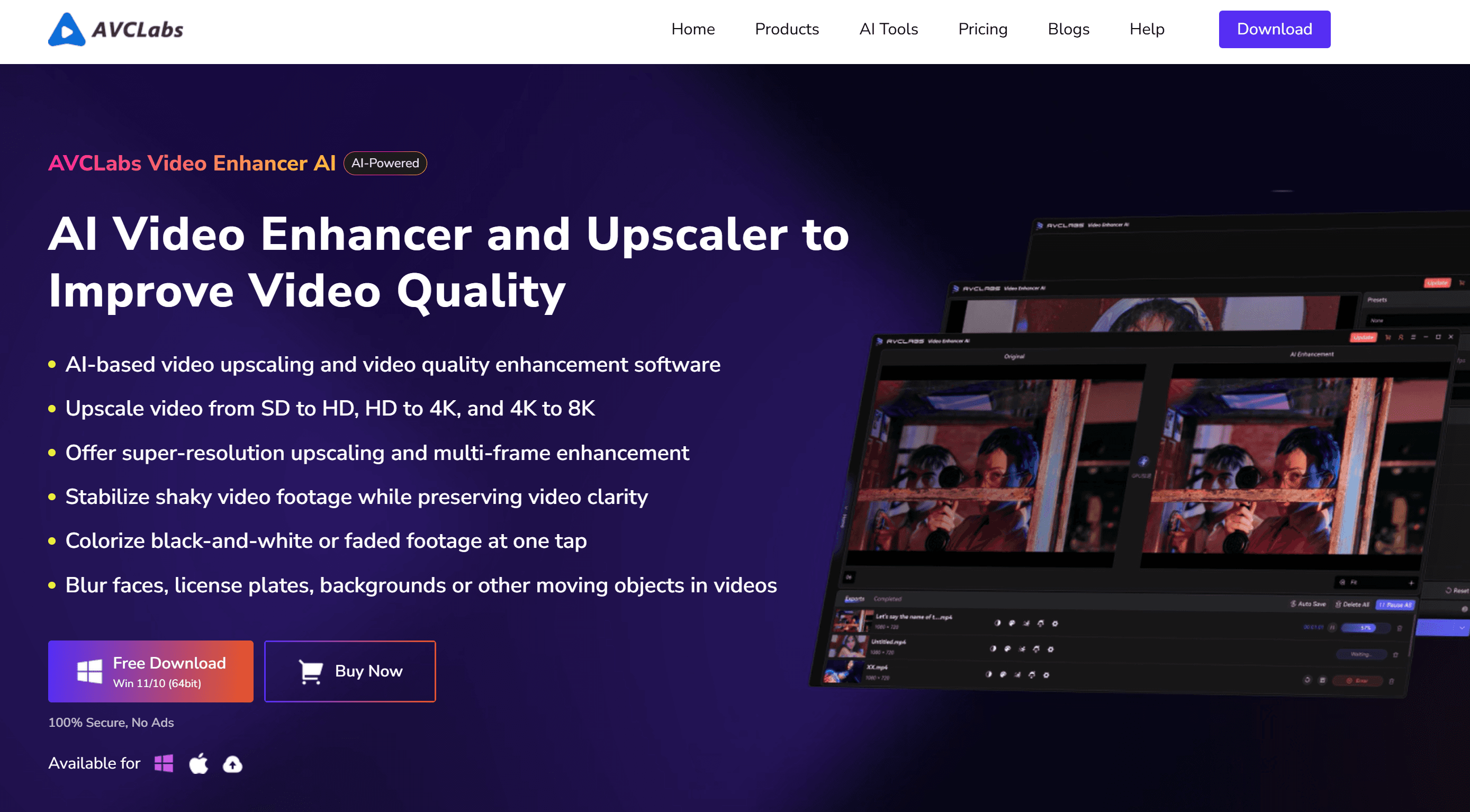
AVCLabs Video Enhancer AI is desktop software that uses AI algorithms to improve video quality. It's a deep-learning tool that can upscale low-resolution footage to HD, 4K, and 8K, remove noise and compression artifacts, reconstruct blurry faces, colorize black-and-white video, boost frame rates, stabilize shaky handheld footage, and blur faces and license plates for privacy.
The company behind AVCLabs was founded in 2006 as a sub-brand of Any Video Converter and moved into AI-driven visual processing in 2021. The January 2026 update (V5.3.0) brought several additions: a Premium AI Colorization model, SDR-to-HDR conversion, a Detail Balance parameter, and an AI object removal tool. All processing happens locally, which makes it a practical choice for users who need AI restoration without uploading footage to cloud services.
Key Features
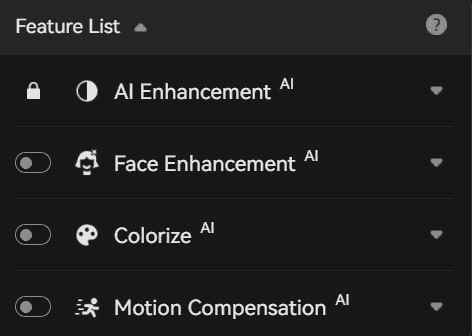
AVCLabs bundles multiple AI models under a single license. As of version 5.3.0, the software offers six enhancement models plus separate face, colorize, motion, and blur modules. Here's what each one does.
AI Upscaling (SD to HD, 4K, 8K)

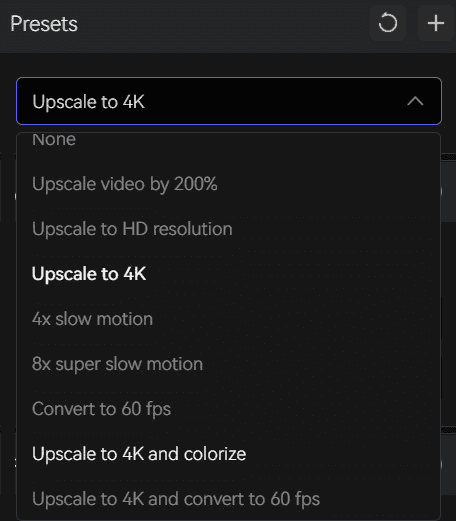
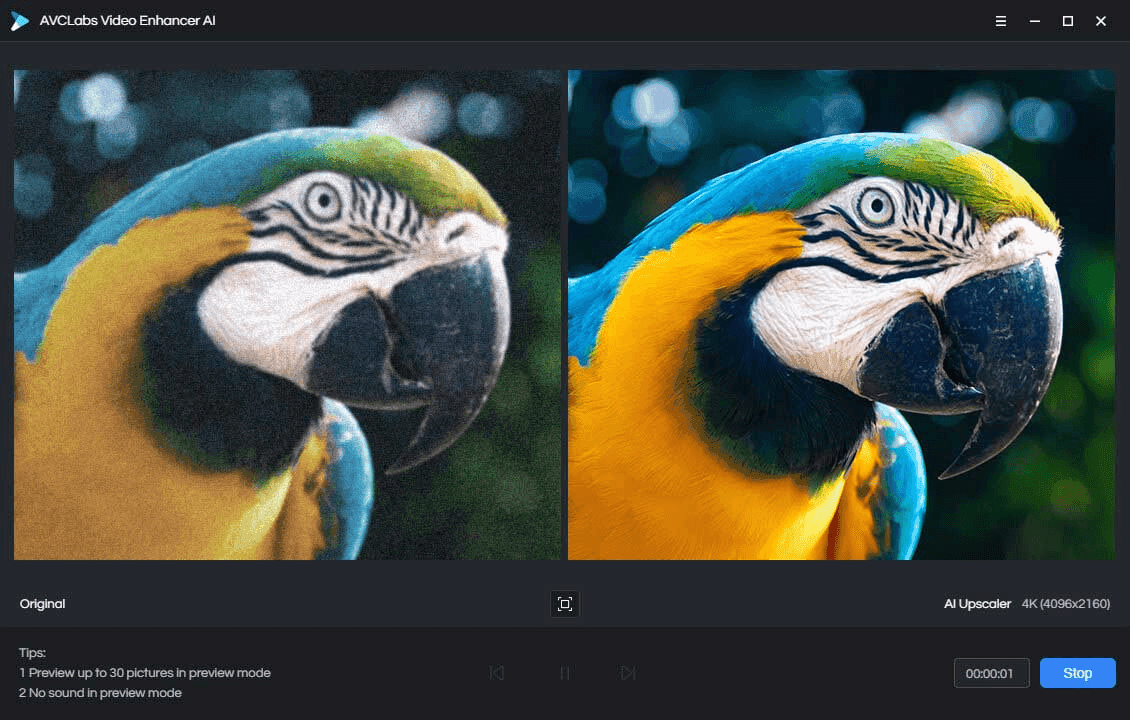
AVCLabs uses neural-network-based super-resolution to increase video resolution from SD to HD, HD to 4K, and even 4K to 8K. Traditional upscaling just stretches pixels and produces a blurry result. The AI instead analyzes each frame and reconstructs missing detail based on patterns learned from millions of images. The Standard model is fast and handles most footage well. The Ultra (Multi-Frame) model analyzes multiple frames at once for better temporal consistency, but processing takes much longer.
AI Denoising and Artifact Removal

The denoising module uses AI to identify and remove grain, compression artifacts, and low-light noise while preserving underlying detail. This is particularly useful for footage shot in poor lighting, old VHS rips, or heavily compressed downloads.
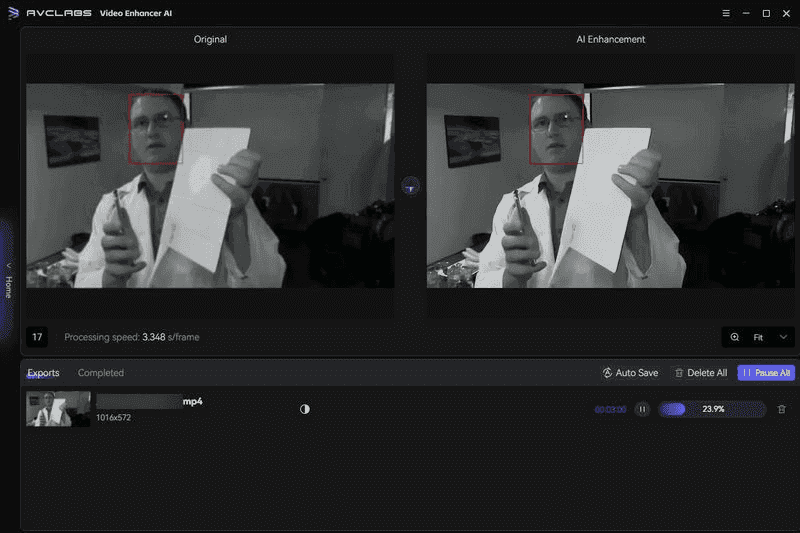
Face Enhancement
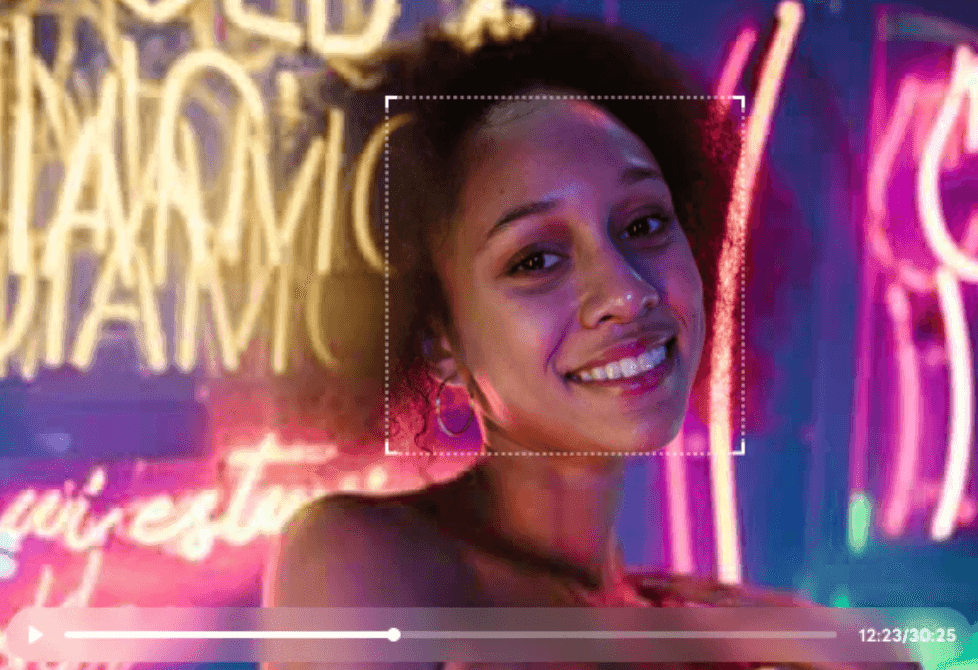
AVCLabs was one of the first video enhancers to integrate AI-powered face detection and refinement. The AI detects faces in each frame and enhances them separately from the rest of the scene, reconstructing blurred features and refining skin texture. A key differentiator is adjustable intensity: you can dial the strength up or down to prevent the "uncanny valley" effect where faces look over-processed. Topaz Video AI's "Iris" model is generally considered superior for fine facial detail, but AVCLabs offers more control over how aggressive the enhancement is.
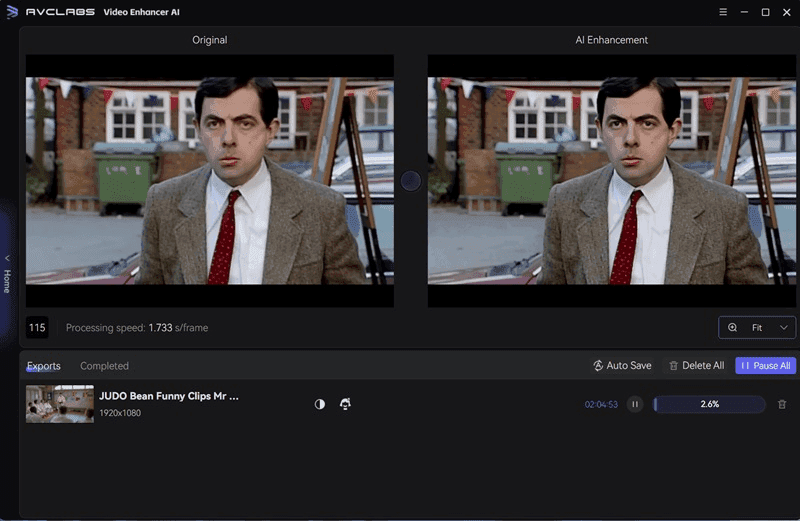
AI Colorization

The AI colorization module applies context-aware color to black-and-white footage, assigning different tones to faces, objects, and backgrounds based on what it detects in each frame. The V5.3.0 update introduced a Premium Colorization Model with more natural and accurate results. Occasional miscoloring can occur, but the output provides a workable starting point for manual correction.
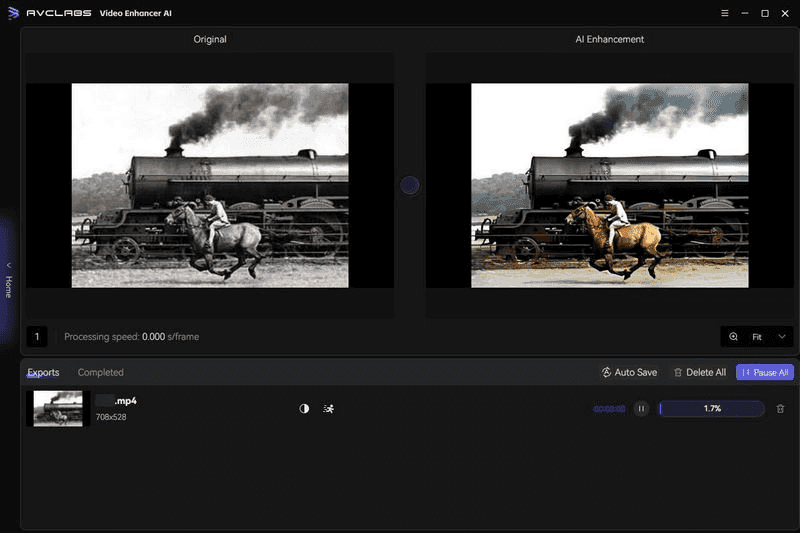
Frame Interpolation (Motion Compensation)
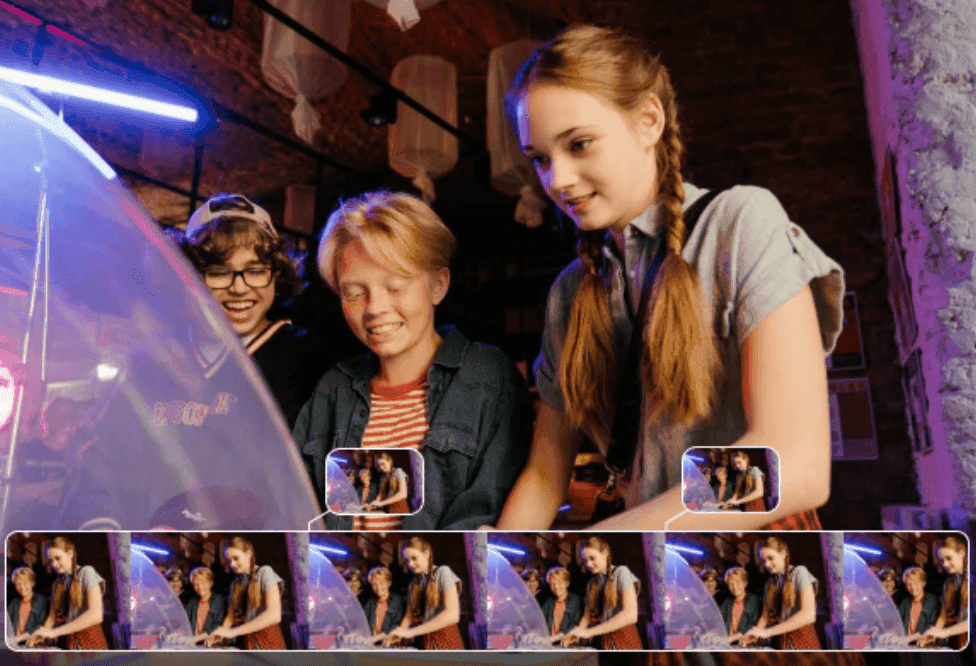
The frame interpolation module uses motion estimation AI to generate intermediate frames and increase the frame rate of video for smoother playback. It's useful for converting 24fps film to 60fps for modern displays, or for smoothing choppy low-frame-rate footage. Results are generally smooth for moderate motion; fast-moving objects or complex scenes can produce artifacts.
SDR-to-HDR Conversion (New in V5.3.0)
Introduced in the January 2026 update, SDR-to-HDR conversion transforms standard dynamic range footage to HDR with wider color gamut and enhanced brightness. Highlights become brighter, shadows deeper, and colors more vivid, without introducing banding or clipping. This previously required separate, expensive tools.
AI Video Blur (Privacy Tool)
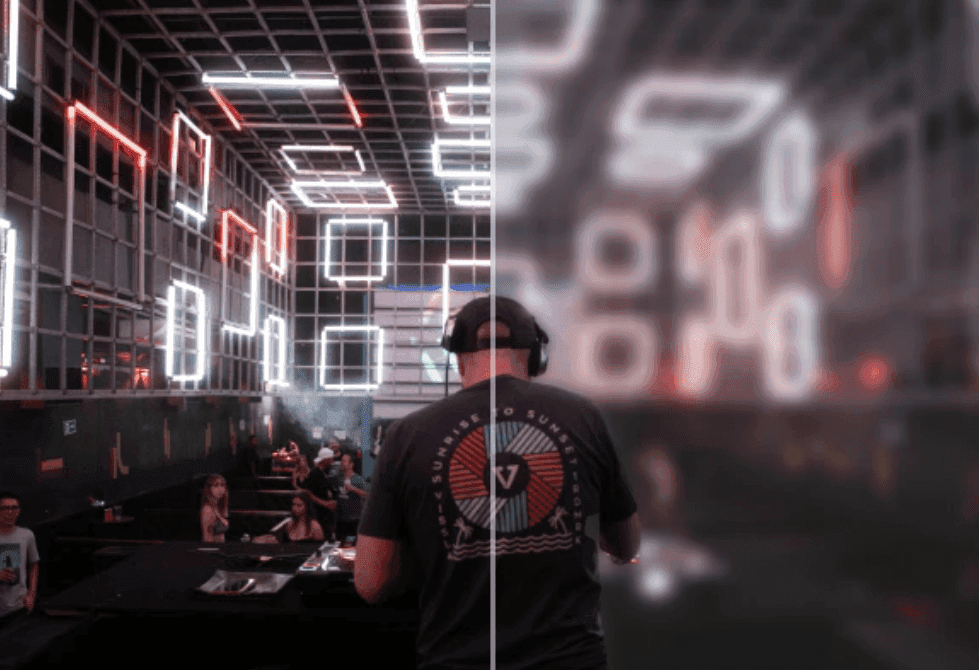
The AI Video Blur module automatically detects and blurs moving objects like faces, license plates, or logos. The V5.3.0 update added an AI Object Removal function that identifies and removes signs, text, or distracting elements from video. Enhanced face import blurring and circular blur shapes offer greater flexibility for irregular areas.
AI Video Stabilization
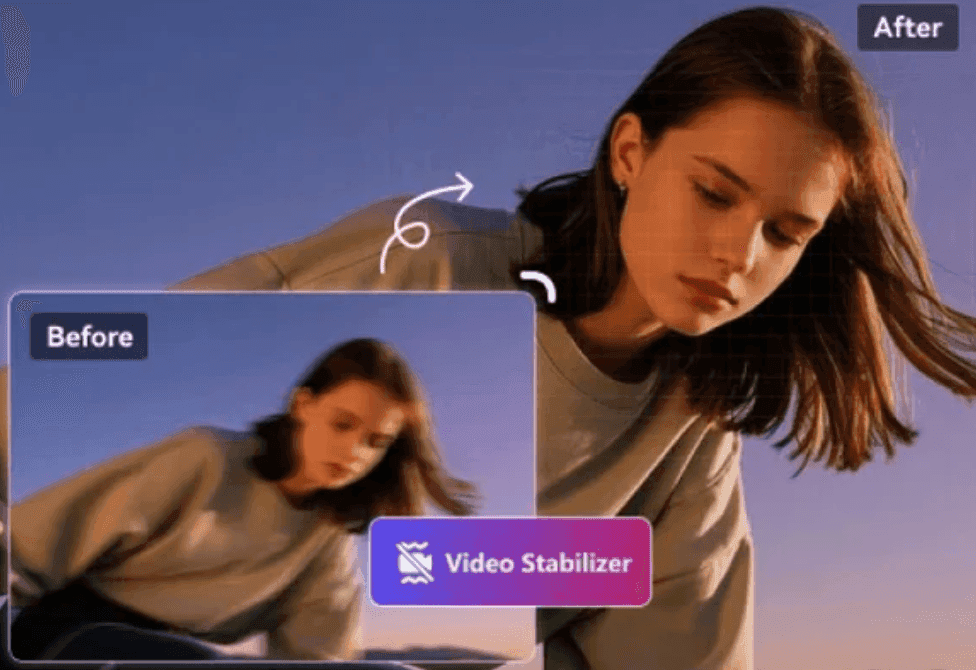
The stabilization module analyzes camera motion and applies corrective transforms to reduce shake and jitter. It works well for handheld footage, action camera clips, and smartphone video where consistent camera movement makes the original difficult to watch.
Additional V5.3.0 Features
The January 2026 update also added:
Grain effect option — Add film grain to enhanced video for a cinematic look
Detail Balance parameter — A slider that reduces over-sharpening, giving finer control over how aggressively the AI reconstructs detail
System Requirements
AI video processing is very demanding on your computer. AVCLabs lists modest minimum requirements on paper, but real-world performance depends almost entirely on your GPU. Here's what you need to know.
Official System Requirements
Component | Minimum | Recommended | Optimal |
OS | Windows 10 (64-bit) / macOS 12 | Windows 11 / macOS 13+ | Windows 11 / macOS 14+ |
CPU | Intel (2015+) or AMD (2016+) | Intel i5 / AMD Ryzen 5 | Intel i7 (7th gen+) / AMD Ryzen 7+ |
RAM | 4 GB (minimum to launch) | 16 GB | 32 GB+ |
GPU VRAM | 4 GB | 6 GB+ | 8 GB+ |
GPU Type | Any dedicated GPU | NVIDIA GTX 1050 Ti+ | NVIDIA RTX 3060+ (TensorRT) |
Storage | 8 GB free | 20 GB SSD | 50 GB NVMe SSD |
GPU Compatibility: What You Need to Know
The GPU is by far the most important component. AVCLabs supports three GPU acceleration backends:
NVIDIA (CUDA + TensorRT) — The primary optimization target. RTX-series cards (RTX 2060 and above) with TensorRT acceleration deliver the best performance. Version 3.2 and above showed notable speed improvements with TensorRT. This is the configuration AVCLabs officially recommends.
AMD — Supported, but noticeably slower. AVCLabs is one of the few enhancers that runs on AMD at all, which makes it attractive for AMD users. But "runs on AMD" is not the same as "fast on AMD."
Intel (OpenVINO) — Added in version 3.0.0 via OpenVINO optimization. Works for basic tasks but is not suitable for serious restoration work.
Apple Silicon (M1/M2/M3) — Supported on macOS, but performance is much slower than NVIDIA RTX with TensorRT.
If you're planning to process 4K or 8K video regularly, an NVIDIA RTX 3060 or better is effectively a requirement. Systems without a strong dedicated GPU will experience very long processing times that make the software impractical for anything beyond short clips.
Pricing and Plans
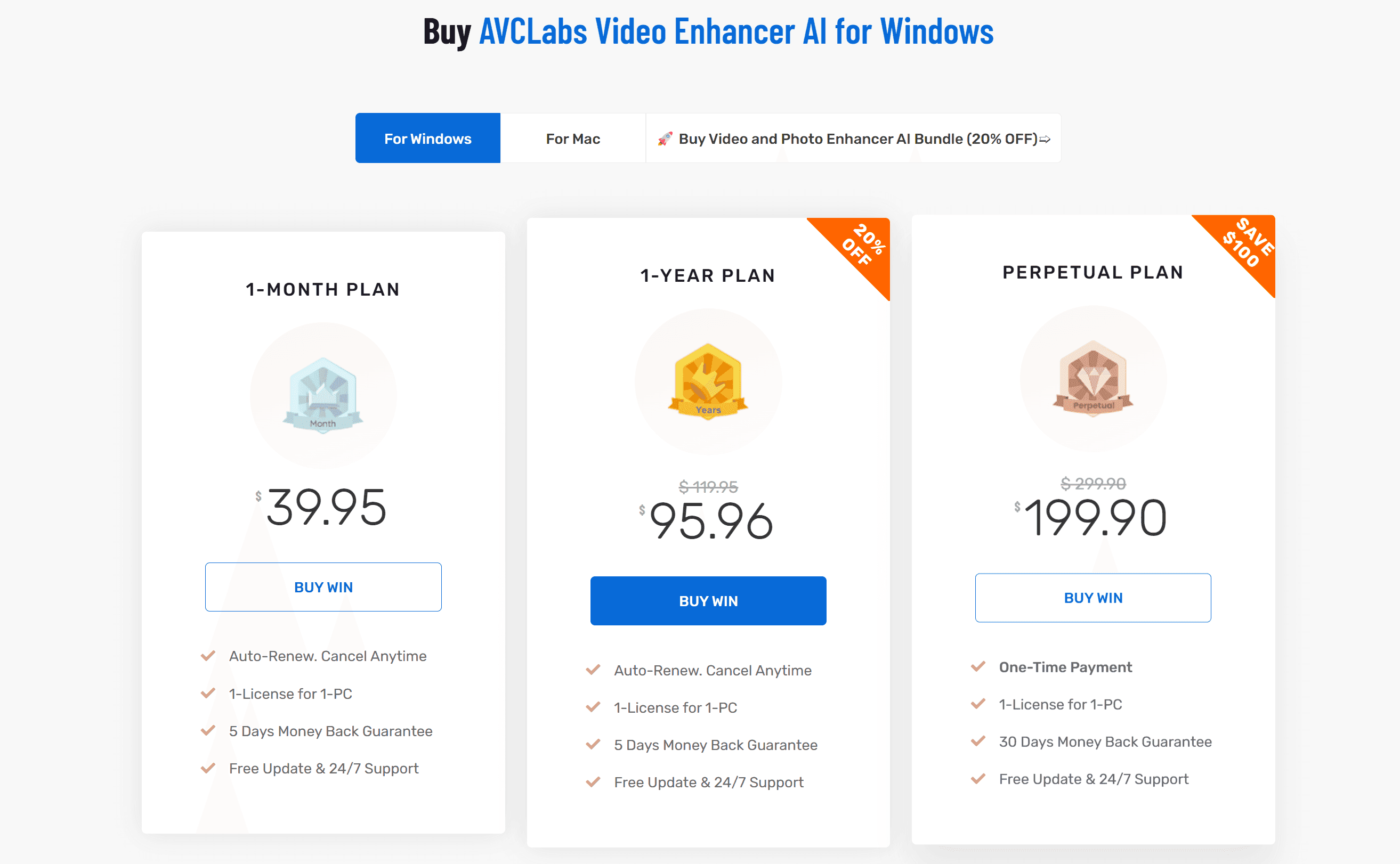
As of our 2026 review, AVCLabs is running a promotion that makes its lifetime plan much more affordable. Here's the complete pricing breakdown:
Plan | Price (USD) | Billing | Refund Policy | Best For |
1-Month Plan | $39.95/month | Auto-renews | 5-day money-back | Short-term projects, testing |
1-Year Plan | $95.96/year (was $119.95) | Auto-renews | 5-day money-back | Regular content creators |
Perpetual (Lifetime) Plan | $199.90 (was $299.90) | One-time payment | 30-day money-back | Long-term users, archival work |
All plans include access to every AI model (upscaling, denoising, face enhancement, colorization, frame interpolation, stabilization, and blur), free software updates, and 24/7 support. After purchasing, you can also request access to AVCLabs' online AI tools using your order information.
The perpetual lifetime license is currently priced at $199.90 during the 2026 promotion, down from the regular $299.90. This one-time payment includes all current AI models, free software updates, and a 30-day money-back guarantee. For regular users, it's the most cost-effective option.
Which Plan Is Best?
For most users, the lifetime plan at $199.90 is the strongest value. If you restore or upscale videos more than a few times per year, it pays for itself within six months compared to the monthly plan. The 30-day money-back guarantee gives you a full month to test it on your own hardware and footage.
Pro-Tip: Always download the free trial first. It will have limitations (like a watermark and 30-second export cap), but it lets you see the exact results on your own videos and hardware before you commit.
Free Trial Limitations
AVCLabs offers a free trial with full feature access, but with important restrictions:
Export limit: Each video export is capped at 30 seconds
Watermark: All trial exports carry a watermark
Conversion limit: The trial allows approximately 3 watermarked video conversions
Feature access: All AI models are available to test, including upscaling, denoising, face enhancement, colorization, and motion compensation
The 30-second export limit is more restrictive than some competitors. UniFab, for example, offers a 30-day watermark-free trial with full feature access. Still, it's enough to evaluate output quality on your own footage before purchasing.
Performance and Benchmarks
Here's what to expect from AVCLabs in real-world use.
Speed and GPU Acceleration
Processing speed depends almost entirely on your GPU and the AI model you select. Based on published benchmarks from multiple sources, here's what you can expect:
Task | Hardware | Processing Time |
30-sec 720p to 4K (Standard) | RTX 4070 | ~2.5 minutes |
30-sec 720p to 4K (Ultra/Multi-Frame) | RTX 4070 | ~8 minutes |
10-min 1080p to 4K | NVIDIA RTX (recommended) | 30 to 60 minutes |
2min25s 480p to 720p | RTX 3060 (laptop) | ~1 hour 10 minutes |
Key takeaways from these benchmarks:
Standard vs. Ultra model: The Ultra (Multi-Frame) model takes roughly 3x longer than Standard but produces better temporal consistency. Use Standard for quick previews and Ultra for final output.
NVIDIA TensorRT: If your computer has a dedicated NVIDIA RTX GPU (RTX 2060 and above), enabling TensorRT acceleration in settings boosts processing speed while reducing GPU memory usage. This is the single biggest performance lever available.
AMD and Apple Silicon: Expect processing times 2 to 3x longer than equivalent NVIDIA RTX hardware. The Ultra Multi-Frame models are particularly affected.
Multi-Frame models demand at least 6 GB of VRAM for stable performance. Systems without strong GPUs may crash or take impractically long on these models.
Supported Formats
AVCLabs accepts common input containers including MP4, M4V, MOV, MKV, and others. Output is currently limited to MP4 format only. While the output container is restricted, the software supports multiple codecs under the hood, including H.264 and H.265 (HEVC). This covers the needs of most professional workflows, though users who need MOV or ProRes output will have to convert in a separate step.
Pros and Cons Summary
Pros | Cons |
✅ Good Output Quality: Improves most footage with realistic detail recovery. | ❌ High Hardware Demand: You need a powerful PC, especially a good NVIDIA GPU. |
✅ Strong Face Enhancement: Adjustable intensity is a useful differentiator. | ❌ Slow on non-NVIDIA GPUs: AMD and Mac users will have much longer render times. |
✅ Full Local Processing: Great for privacy; no uploads needed. | ❌ Pricey (Without Sale): The $299.90 regular price is a high investment. |
✅ All-in-One Tool: Upscale, denoise, colorize, stabilize, blur, and now SDR-to-HDR. | ❌ Faces Can Look "Artificial": On rare occasions, the face model can over-compensate. |
✅ Easy to Use Interface: Very beginner-friendly with one-click workflows. | ❌ Challenging Footage: Still struggles with very complex nature scenes (foliage, etc.). |
✅ Good Current Sale Price: The $199.90 perpetual plan is a strong value. | ❌ Restrictive Trial: 30-second export limit and watermark make evaluation difficult. |
✅ 2026 Feature Updates: SDR-to-HDR, Premium Colorization, AI Object Removal. | ❌ MP4-Only Output: No option to export in MOV, MKV, or other containers. |
The cons above paint a clear picture: AVCLabs demands a strong GPU, costs $199.90 even on sale, and limits trial exports to 30 seconds. If your main goal is upscaling everyday video to 4K and smoothing frame rates, those trade-offs may not be worth it. That's where a more focused tool like Nero AI Video Upscaler comes in. It costs $70 less, runs on lighter hardware, and covers the most common upscaling needs without the complexity of six AI models.
Nero AI Video Upscaler: A Smart Alternative to Consider
Nero AI Video Upscaler takes a more focused approach to video enhancement.

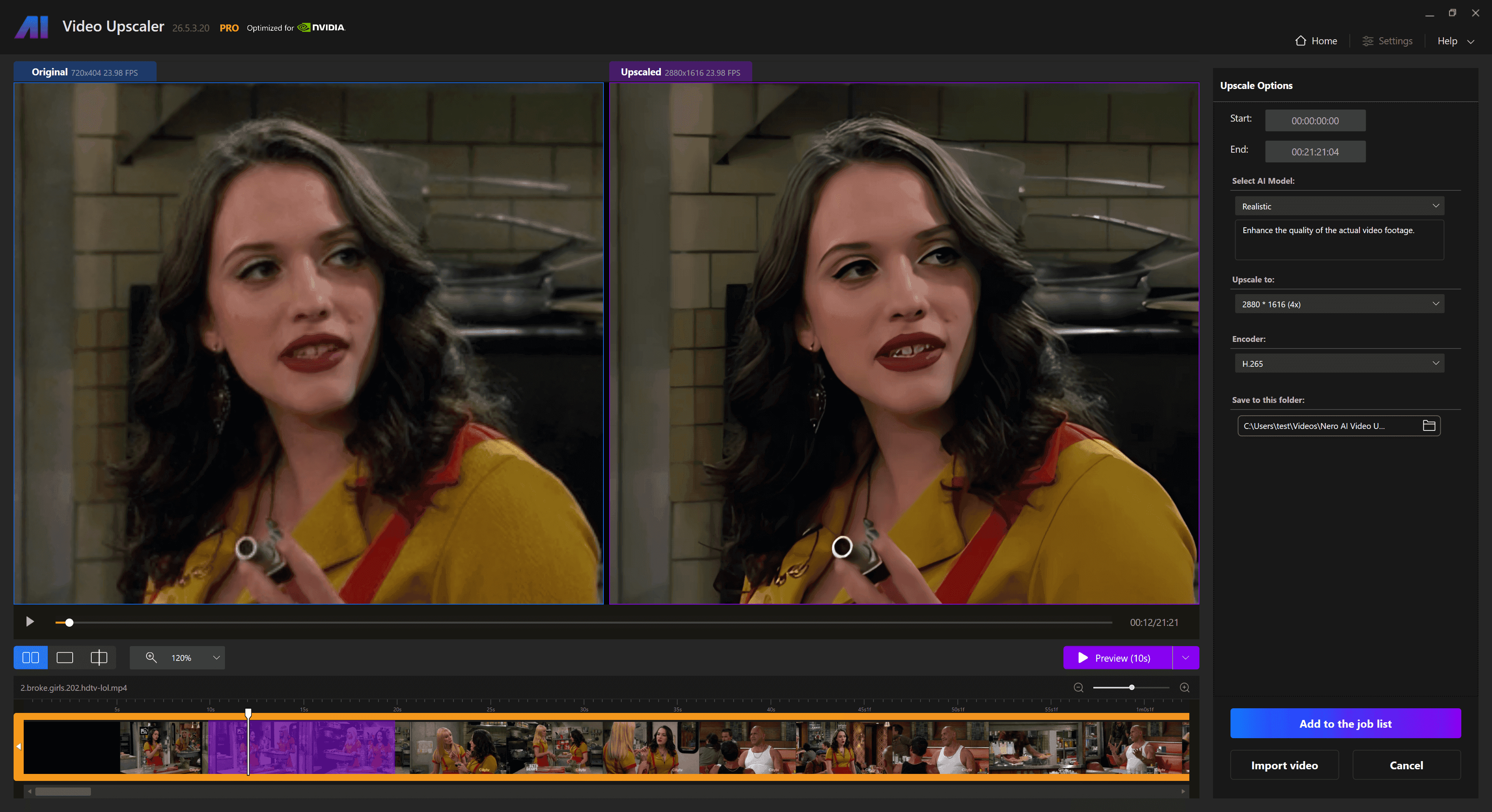
Nero (the company behind the famous DVD burning software) offers its own AI-powered video upscaler. It targets 4K upscaling with frame rate boosting up to 120fps and a face enhancement mode, all through a streamlined interface that doesn't require configuring multiple AI models.
AVCLabs vs Nero: Head-to-Head
Dimension | AVCLabs Video Enhancer AI | Nero AI Video Upscaler |
Price (Lifetime) | $199.90 | $129.95 |
Max Resolution | 8K (needs RTX 3060+, 8GB+ VRAM for practical speed) | 8K (covers most creator and consumer needs) |
Frame Rate Boost | Frame interpolation available | Up to 120fps, a standout strength |
Face Enhancement | Adjustable intensity | Face enhancement mode |
Hardware Requirements | High; NVIDIA RTX recommended for usable speed | Lower; more forgiving on mid-range GPUs |
Extra Specialized Tools | Colorization, SDR-to-HDR, video blur, object removal | Focused toolset for upscaling and frame rate work |
Learning Curve | Multiple models and parameters to configure | Streamlined for quick upscaling workflows |
Value for Everyday Upscaling | Priced for deep restoration; overkill for basic 4K | $70 less, built for daily use |
AVCLabs justifies its higher price if your work falls into specialized territory: archival restoration, colorization, or SDR-to-HDR conversion. For general upscaling and frame rate boosting, Nero handles the job at $70 less with friendlier hardware requirements and a simpler workflow.
Recommendation: Whether AVCLabs fits your budget or not, Nero AI Video Upscaler is worth downloading and comparing side by side. It's our top-rated pick in the 5 best AI video enhancers for Windows in 2026.
Get started today by downloading Nero AI Video Upscaler.
FAQ
Is AVCLabs Video Enhancer AI free?
No. The free trial gives full feature access but limits exports to 30 seconds with a watermark and approximately 3 conversions. Paid plans start at $39.95/month, with a lifetime license at $199.90 during the current promotion. There is no fully free version.
Is AVCLabs Video Enhancer AI safe?
Yes. All processing happens locally with no cloud uploads, and the software is malware-free when downloaded from the official website. Avoid cracked versions, which may contain malware. Monthly and yearly plans include a 5-day money-back guarantee; the lifetime license includes 30 days.
How do I use AVCLabs Video Enhancer AI?
Download and install from avclabs.com, then follow three basic steps:
Import — Drag your video in or use the Add Video button
Configure — Pick an AI model for your footage type, set the target resolution, and enable NVIDIA TensorRT in Preferences if you have an RTX card
Export — Preview a short segment, then process. Output is MP4 only (H.264 or H.265)
Does AVCLabs work on Mac?
Yes. It supports macOS 12 and above, including Apple Silicon (M1/M2/M3). Processing on Apple Silicon is slower than NVIDIA RTX with TensorRT, so expect longer render times.
Does AVCLabs support AMD GPUs?
Yes, but performance is much slower than NVIDIA RTX with TensorRT. Intel integrated graphics are also supported via OpenVINO (added in V3.0.0) but aren't recommended for serious work.
Can AVCLabs upscale video to 4K or 8K?
Yes. The Standard model handles 4K efficiently. Ultra (Multi-Frame) provides higher quality at longer processing times. Practical 8K output requires a powerful GPU with at least 8 GB VRAM.
Final Verdict
AVCLabs Video Enhancer AI is a capable, feature-rich tool best suited for users with specialized restoration needs and a strong NVIDIA GPU. At $199.90 for a lifetime license, it delivers solid value if you need colorization, SDR-to-HDR, face refinement, or archival work in a single local-processing application.
Buy AVCLabs if you do archival restoration, need AI colorization, or want local-only processing with an RTX GPU.
Skip it if you mainly need frame rate boosting. Nero AI Video Upscaler does that at $70 less with friendlier hardware, and Topaz Video AI offers finer quality control for professionals.