You film a youth football match. You edit the highlights. You post it on YouTube.
Somewhere in that footage are faces of people who never consented to being identified online. Under GDPR, that's not just a technicality — it's a potential enforcement action.
This isn't a hypothetical risk. Regulators have made it clear that face data in video is biometric data, and biometric data is one of the most tightly controlled categories under EU law.

What the Law Actually Says
Under GDPR Article 9, facial images qualify as biometric data when they're used to uniquely identify a person. Publishing a video of someone's face online — without consent — can constitute unlawful processing of special category data. For sports clubs, the financial penalties for non-compliance can reach up to €20 million or 4% of worldwide revenue, whichever is higher.
And it's not just clubs or organizations. Individual creators publishing footage of recognizable people — athletes, spectators, bystanders, children — are subject to the same rules.
Real Cases Where It Went Wrong
Case 1: The school that used facial recognition for attendance
A Swedish school ran a three-week trial using cameras to automatically take class attendance via facial recognition. They had parental consent forms. They stored data on a local, offline computer. They thought they were covered.
The Swedish DPA fined the school and issued a warning against further processing — finding three separate GDPR violations: processing facial data more intrusively than necessary, processing biometric data without a valid legal basis, and failing to conduct a proper data protection impact assessment.
The lesson: collecting faces "for convenience" — even with apparent consent — isn't enough. The regulator's position was that less privacy-invasive alternatives (like a paper register) should have been used instead.
Case 2: Clearview AI — facial images scraped from the internet
The Dutch Data Protection Authority fined Clearview AI €30.5 million for illegally scraping facial images from the internet without consent, creating a biometric database that violated GDPR. The DPA is also considering holding the company's directors personally accountable.
The direct parallel for video creators: any footage you publish that allows someone to be identified by their face is effectively contributing biometric data to the public internet — without their consent.
Case 3: The trajectory of enforcement
These aren't isolated incidents. By January 2025, the cumulative total of GDPR fines has reached approximately €5.88 billion, and European regulators have expanded their focus well beyond big tech — now scrutinizing finance, healthcare, energy, and media sectors. Small organizations are increasingly in scope.
The Sports Video Problem Is Structural
Sports footage is uniquely difficult to manage manually:
Crowds move unpredictably. You can't track 20 faces frame-by-frame.
Minors are often present. Photos and videos of children are classed as personal data by law, and organizations storing or publishing footage of children must follow strict data protection requirements.
Bystanders don't consent. Spectators, parents on the sideline, passersby — none of them signed a release.
Live streams are even riskier. If you want to livestream an event, you should inform parents and children in advance and gather consent for filming before broadcasting. At a public match, that's rarely practical.
The only scalable solution is automated redaction.
How Nero Motion Tracker Handles This
Nero Motion Tracker uses AI to automate the redaction workflow that would otherwise take hours.
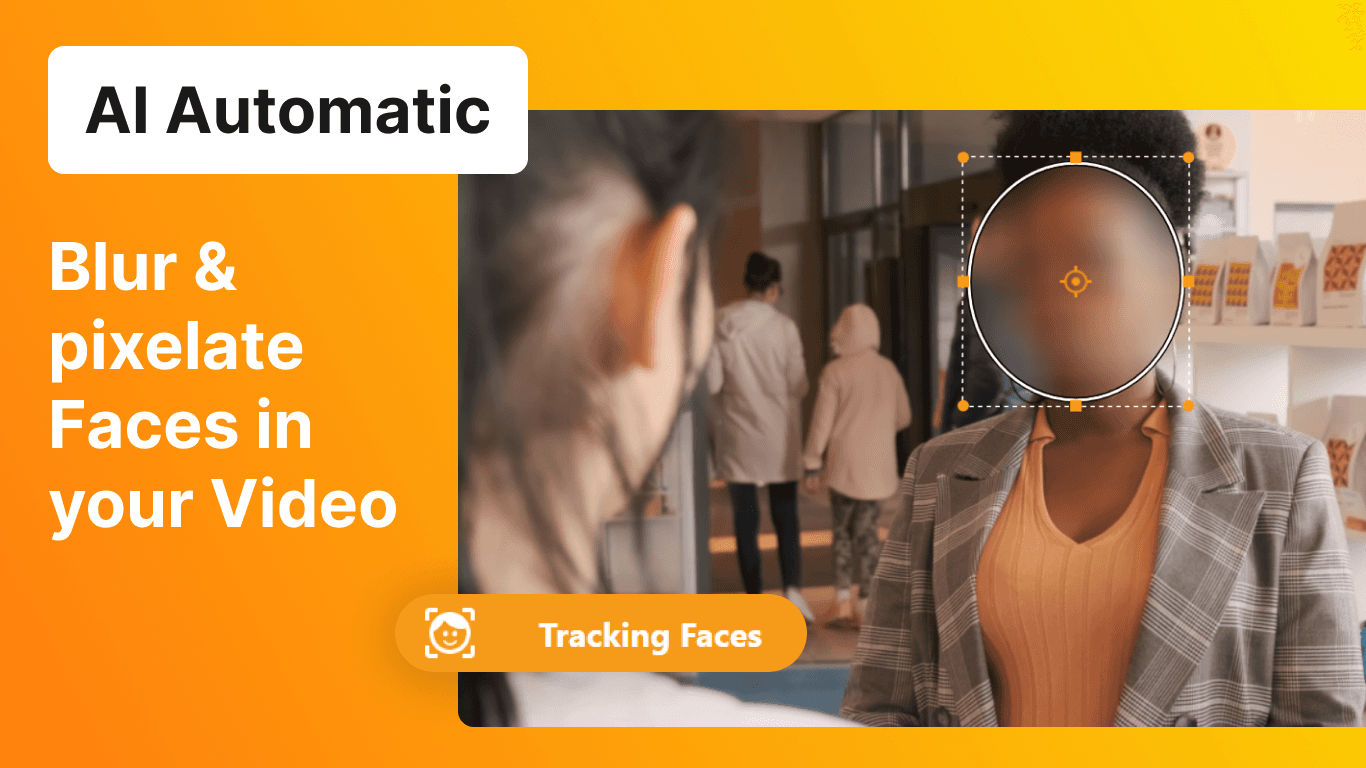
Face Tracking — Automatically detects and follows every human face in the video. No manual selection needed — the AI finds the faces itself and keeps the blur locked on as subjects move, turn, or are briefly obscured. The right tool when you need to anonymize identifiable people in a crowd.
Segment Tracking — Tracks any moving object by its exact outline — a full person, a car, a bag, anything with a distinct edge. Instead of a rough bounding box, the mosaic or blur follows the precise contour of the subject across every frame. Use this when you need to redact an entire person's silhouette, not just their face, or when the subject isn't a face at all.
Zone Tracking — You draw a rectangular region on the frame, and the tracker follows that specific area as it moves through the video. Fast and lightweight, ideal for covering a jersey number, a name on a shirt, a license plate in the background, or any fixed detail you want permanently obscured throughout the clip.
Download Nero Motion Tracker Free →
Practical Guide: Which Mode for Which Scenario
Scenario | Recommended Mode |
|---|---|
Youth match — blur all faces in the crowd | Face Tracking |
Spectators visible in background of highlights | Face Tracking |
Redact an entire person, not just their face | Segment Tracking |
Follow and blur a specific player who hasn't consented | Segment Tracking |
Cover a jersey number or name throughout the clip | Zone Tracking |
Blur a license plate visible in the background | Zone Tracking |
Post-match interview — protect interviewee's identity | Face Tracking |
The Workflow: Compliance in 5 Steps
Import your sports clip into Nero Motion Tracker
Choose a mode — Face, Segment, or Zone
Apply your effect — mosaic or blur
Preview the result
Export as MP4, no quality loss
From raw footage to compliant video, in minutes.
Final Thoughts
GDPR enforcement is accelerating, regulators are looking beyond big tech, and faces in video are one of the clearest liability areas for content creators. The technology to fix this is now simple enough that there's no reason to publish unredacted footage of people who didn't consent.